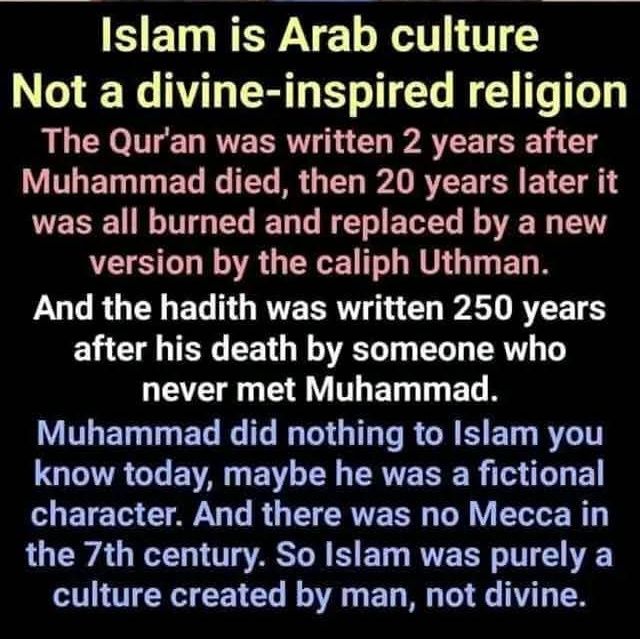
I said a month ago that all of these mystical enslaver religions are nothing but their canonized culture in a book their ruling class men sanctioned as holy. Most of the prophets are made up, because there is zero direct evidence they ever lived, nothing. Later in the month an African youth asked me to explain because her "master teachers " said that the Arabs and Europeans got their religions from Blacks. This is pure dumb and lazy made up nonsense from these unscrupulous unscientific windbags running around our communities unchecked. Lies. And these unprepared negroes ought stop misleading our children who are searching for scientific answers.

I will detail my discussion with the Black youth, then apply my thesis to a step by step scientific analysis of Arab historical enslavers of Africans and their Islam.

Analysis of Religion as Canonized Culture:

1. Our primary inference is that all religion encodes a people’s worldview.

Religions sanctify and preserve a society’s core values, norms, and beliefs: ideas about right and wrong, good and bad, gender roles, family life, authority, destiny, death, nature, and the unseen world. They canonize that worldview — formalize it into stories, rituals, rules, sacred texts, commandments, scriptures, suras, guiding principles and later institutions — so that it can be transmitted across generations.

2. Religions are “remembered, then packaged, printed, and preserved in a mystical form.”

The symbolic and mystical layer gives culture mysterious but emotional power and legitimacy. Myths, miracles, sacred narratives, and rituals make cultural expectations feel cosmic rather than merely social. This is why religious systems are durable: they bind memory, identity, and morality to something transcendent.

3. “Overwhelmingly by men.”

Historically, the gatekeepers of theology, priesthoods, scriptural interpretation, church councils, and temple hierarchies have been male-dominated nearly 99% of all cases. That shaped:
which stories became canonical versus apocryphal,
how gender roles were justified,
who had authority to speak for the divine,
and how dissent was handled.
Women (and marginalized communities) often contributed deeply through practice, song, ritual care, mysticism, and local leadership — but their influence was frequently informal and rarely canonized, especially with Islamic desert nomadic male centered culture.

4. This is why religion often stabilizes social hierarchies rather than overturning them.
Why religious reform movements emerge when lived culture outgrows old canons.
Why conflicts arise when “sacred” norms collide with social change.
Why religion can both inspire liberation and justify oppression — it preserves the culture that produced it, for better and worse.
The “canon” decides what counts as legitimate, and power (historically male) decides the canon.

A Scientific Review of Islam

A scientific reading of any ideology begins from the premise that ideas do not float above life; they condense, rationalize, and discipline the concrete social relations of the people who produce them---based on their own cultural stage of development or underdevelopment in the case of mystical desert nomadic warring Arab tribal groups that forged Islam in the deserts of Saudi Arabia. Pure savagery unleashed as they jihadded from society to society conquering, pillaging, seizing territory, stealing anything not nailed down, enslaving the defeated populations and dividing up the spoils of war. Today they follow the exact same method only with modern weapons of war...

When applied to the Qurʾān, the hadith corpus, and the later evolution of sharīʿa, this approach shows that religious doctrine did not arise in a vacuum but emerged out of the environmental, economic, and social stresses of the Arabian Peninsula: a harsh desert ecology; semi-nomadic pastoralism; chronic tribal warfare; overwhelmingly oral, non-literate communication; and a patriarchal domestic order in which male dominance was embedded in the material division of labor. In such conditions, a religious-legal system inevitably mirrors the realities it seeks to control, stabilize, or elevate.

The desert shaped everything. Scarcity of water and pasture meant that social groups lived in a precarious equilibrium, always one drought away from collapse. In this environment, tribes depended on livestock mobility, protective alliances, vengeance codes, and raiding (ghazw) for survival. The Qurʾān’s constant emphasis on gratitude for rain, livestock, shade, caravans, “the earth spread out,” or “gardens beneath which rivers flow” is not abstract theological poetry but the ideological echo of a world where rain meant life and a failed pasture meant starvation. Hadith that describe the virtues of digging wells, caring for camels, dividing water rights, or sharing pastureland directly address disputes central to pastoral life. Sharīʿa’s property rules—meticulous about grazing land, wells, and irrigation channels—extend this logic, formalizing norms that had been regulated informally by tribal elders.
Violence and warfare in scripture likewise reflect the nomadic social structure.

Tribal Arabia lacked a unified state; security came from lineage solidarity and the obligation to avenge insult or injury. Warfare was frequent, small-scale, and often economically motivated—seizing animals, women, goods, or territory. The Qurʾān’s repeated discussions of fighting, treaty observance, blood-money, spoils, captives, and reconciliation mirror a society in which every adult male had military duties, and every breach of honor risked a feud spiraling into annihilation. Verses that prescribe fighting “when necessary,” regulate division of spoils, or condemn treachery are ideological strategies to discipline the violent economy of raiding and redirect it toward the emerging communal project. Hadith expand these rules into a practical manual: who gets what share in a raid, what counts as legitimate booty, when killing is prohibited, how captives may be ransomed or integrated, how truces are negotiated.

Sharīʿa then systematizes these norms into jurisprudence, turning spontaneous raiding into regulated warfare and channeling violence into predictable, state-like forms.
The punitive severity associated with cutting off hands, stoning, or lashing becomes intelligible in context. A pastoral society with no prisons, no bureaucracy, and limited means of surveillance required punishments that were immediate, visible, and socially enforceable. The desert had no carceral infrastructure; punishment had to be swift, exemplary, and deterrent. A missing camel or a stolen sack of grain could determine whether a family survived the season. Harsh penalties were not simply theological absolutism but the legal codification of a world where theft or adultery carried catastrophic material consequences.

Qurʾānic hudūd laws, hadith elaborations about proof standards, and sharīʿa differentiation between theft in conditions of famine versus theft from secure property all reflect an attempt to impose order on a fragile economic base. Even the stringent evidentiary requirements show that the law sought to balance the need for deterrence with the danger of false accusations in a society where reputation was everything.
Patriarchal domestic structure similarly arises from material conditions. In a nomadic pastoral economy, men’s roles involved warfare, large-scale herding, caravan trade, and physical protection of the camp; women’s roles centered on managing tents, domestic production, food processing, weaving, and child-rearing. These functional divisions, rooted in survival imperatives, crystallized into ideological doctrines of male authority.

The Qurʾān’s assignment of men as “qawwāmūn” (maintainers) over women reflects the fact that men controlled mobility, wealth accumulation, and armed protection. Hadith reinforce norms of obedience, sexual exclusivity, and modesty that secure lineage certainty—vital in genealogical societies where inheritance and honor depend on unbroken male descent lines. Sharīʿa institutionalizes these relations through marriage contracts, guardianship (walāya), polygyny, inheritance rules prioritizing male agnates, and legal requirements for testimony or divorce procedures. These are not arbitrary theological decrees but the juridical expression of desert patriarchy, structured by the need for clear paternal lineage in a world where property was primarily mobile livestock and where group survival required tightly organized gender roles.

The strong emphasis on oral transmission and memorization in both Qurʾān and hadith directly corresponds to a 99 percent illiterate population. Revelation had to be formulated in rhythmic, recitable prose; law had to be encoded in concise narrations that could be memorized and transmitted without writing. The authority of reciters, storytellers, and transmitters reflects the material communication system available. Even the later monumental project of hadith compilation—meticulous chains, biography of narrators—arises from the transition from oral authority to written administration as urban centers grew and literacy increased. Sharīʿa’s dependence on textual proof is thus historically contingent: doctrine matured only once the material conditions (paper markets, courts, urban judges, bureaucratic scribes) made writing the backbone of legal authority.
The rise of sharīʿa itself marks a shift from tribal customary norms to a trans-tribal legal order suited to expanding settlements and early state formation.

As the community expanded beyond Mecca and Medina and incorporated sedentary populations, agriculture, taxation, and state revenue, the legal system grew more complex. Rules on contracts, inheritance, markets, endowments, and taxation reflect the needs of a society now managing permanent property, surplus extraction, and long-distance administration. The law’s sacred aura masked its deeply practical function: stabilizing property rights, organizing labor, regulating slavery, supervising markets, and providing dispute resolution across previously incompatible tribal codes.

Taken together, the Qurʾān, hadith, and sharīʿa form an ideological superstructure produced by a specific material base: desert ecology, pastoral economy, tribal fragmentation, male-centered kinship, and limited literacy. The doctrines answer the problems of that world—organizing violence, structuring redistribution, codifying patriarchy, protecting scarce resources, and disciplining social behavior. The religious form universalizes what were historically contingent conditions, transforming the vulnerabilities of Arabian life into eternal commandments. Cutting off hands and feet. Legs and arms, cutting of heads, beheading, stoning people to death, castrated Black boys well into the millions to make eunuchs to guard these rotten Arab harems filled with millions of Black girls--- this is merely desert nomadic warring tribal religious law sanctioned and attributed to their desert nomadic gods.

From a scientific standpoint, the sacred text becomes the mirror and regulator of the world that produced it. Nothing special. And no, Africans absolutely did not teach them this desert nomadic warring tribal division of contraband Arab cultural law canonized as their religion---Islam.

Black folk enslaved by these invaders for over 1480 years need to stop ignorantly and disgracefully claiming things they do not understand. Strung out like crackheads on enslaver made up religions, Blacks need to stop being so intellectually lazy. Create your own moral systems from your own unique cultures.

Stop lying to our children, keeping them crawling around with these enslavers and their religious rackets. Get out of those churches, mosques, and synagogues of your historical enslavers. Have integrity... See less
...read more
I said a month ago that all of these mystical enslaver religions are nothing but their canonized culture in a book their ruling class men sanctioned as holy. Most of the prophets are made up, because there is zero direct evidence they ever lived, nothing. Later in the month an African youth asked me to explain because her "master teachers " said that the Arabs and Europeans got their religions from Blacks. This is pure dumb and lazy made up nonsense from these unscrupulous unscientific windbags running around our communities unchecked. Lies. And these unprepared negroes ought stop misleading our children who are searching for scientific answers.  I will detail my discussion with the Black youth, then apply my thesis to a step by step scientific analysis of Arab historical enslavers of Africans and their Islam.  Analysis of Religion as Canonized Culture:  1. Our primary inference is that all religion encodes a people’s worldview.  Religions sanctify and preserve a society’s core values, norms, and beliefs: ideas about right and wrong, good and bad, gender roles, family life, authority, destiny, death, nature, and the unseen world. They canonize that worldview — formalize it into stories, rituals, rules, sacred texts, commandments, scriptures, suras, guiding principles and later institutions — so that it can be transmitted across generations.  2. Religions are “remembered, then packaged, printed, and preserved in a mystical form.”  The symbolic and mystical layer gives culture mysterious but emotional power and legitimacy. Myths, miracles, sacred narratives, and rituals make cultural expectations feel cosmic rather than merely social. This is why religious systems are durable: they bind memory, identity, and morality to something transcendent.  3. “Overwhelmingly by men.”  Historically, the gatekeepers of theology, priesthoods, scriptural interpretation, church councils, and temple hierarchies have been male-dominated nearly 99% of all cases. That shaped: which stories became canonical versus apocryphal, how gender roles were justified, who had authority to speak for the divine, and how dissent was handled. Women (and marginalized communities) often contributed deeply through practice, song, ritual care, mysticism, and local leadership — but their influence was frequently informal and rarely canonized, especially with Islamic desert nomadic male centered culture.  4. This is why religion often stabilizes social hierarchies rather than overturning them. Why religious reform movements emerge when lived culture outgrows old canons. Why conflicts arise when “sacred” norms collide with social change. Why religion can both inspire liberation and justify oppression — it preserves the culture that produced it, for better and worse. The “canon” decides what counts as legitimate, and power (historically male) decides the canon.  A Scientific Review of Islam  A scientific reading of any ideology begins from the premise that ideas do not float above life; they condense, rationalize, and discipline the concrete social relations of the people who produce them---based on their own cultural stage of development or underdevelopment in the case of mystical desert nomadic warring Arab tribal groups that forged Islam in the deserts of Saudi Arabia. Pure savagery unleashed as they jihadded from society to society conquering, pillaging, seizing territory, stealing anything not nailed down, enslaving the defeated populations and dividing up the spoils of war. Today they follow the exact same method only with modern weapons of war...  When applied to the Qurʾān, the hadith corpus, and the later evolution of sharīʿa, this approach shows that religious doctrine did not arise in a vacuum but emerged out of the environmental, economic, and social stresses of the Arabian Peninsula: a harsh desert ecology; semi-nomadic pastoralism; chronic tribal warfare; overwhelmingly oral, non-literate communication; and a patriarchal domestic order in which male dominance was embedded in the material division of labor. In such conditions, a religious-legal system inevitably mirrors the realities it seeks to control, stabilize, or elevate.  The desert shaped everything. Scarcity of water and pasture meant that social groups lived in a precarious equilibrium, always one drought away from collapse. In this environment, tribes depended on livestock mobility, protective alliances, vengeance codes, and raiding (ghazw) for survival. The Qurʾān’s constant emphasis on gratitude for rain, livestock, shade, caravans, “the earth spread out,” or “gardens beneath which rivers flow” is not abstract theological poetry but the ideological echo of a world where rain meant life and a failed pasture meant starvation. Hadith that describe the virtues of digging wells, caring for camels, dividing water rights, or sharing pastureland directly address disputes central to pastoral life. Sharīʿa’s property rules—meticulous about grazing land, wells, and irrigation channels—extend this logic, formalizing norms that had been regulated informally by tribal elders. Violence and warfare in scripture likewise reflect the nomadic social structure.  Tribal Arabia lacked a unified state; security came from lineage solidarity and the obligation to avenge insult or injury. Warfare was frequent, small-scale, and often economically motivated—seizing animals, women, goods, or territory. The Qurʾān’s repeated discussions of fighting, treaty observance, blood-money, spoils, captives, and reconciliation mirror a society in which every adult male had military duties, and every breach of honor risked a feud spiraling into annihilation. Verses that prescribe fighting “when necessary,” regulate division of spoils, or condemn treachery are ideological strategies to discipline the violent economy of raiding and redirect it toward the emerging communal project. Hadith expand these rules into a practical manual: who gets what share in a raid, what counts as legitimate booty, when killing is prohibited, how captives may be ransomed or integrated, how truces are negotiated.  Sharīʿa then systematizes these norms into jurisprudence, turning spontaneous raiding into regulated warfare and channeling violence into predictable, state-like forms. The punitive severity associated with cutting off hands, stoning, or lashing becomes intelligible in context. A pastoral society with no prisons, no bureaucracy, and limited means of surveillance required punishments that were immediate, visible, and socially enforceable. The desert had no carceral infrastructure; punishment had to be swift, exemplary, and deterrent. A missing camel or a stolen sack of grain could determine whether a family survived the season. Harsh penalties were not simply theological absolutism but the legal codification of a world where theft or adultery carried catastrophic material consequences.  Qurʾānic hudūd laws, hadith elaborations about proof standards, and sharīʿa differentiation between theft in conditions of famine versus theft from secure property all reflect an attempt to impose order on a fragile economic base. Even the stringent evidentiary requirements show that the law sought to balance the need for deterrence with the danger of false accusations in a society where reputation was everything. Patriarchal domestic structure similarly arises from material conditions. In a nomadic pastoral economy, men’s roles involved warfare, large-scale herding, caravan trade, and physical protection of the camp; women’s roles centered on managing tents, domestic production, food processing, weaving, and child-rearing. These functional divisions, rooted in survival imperatives, crystallized into ideological doctrines of male authority.  The Qurʾān’s assignment of men as “qawwāmūn” (maintainers) over women reflects the fact that men controlled mobility, wealth accumulation, and armed protection. Hadith reinforce norms of obedience, sexual exclusivity, and modesty that secure lineage certainty—vital in genealogical societies where inheritance and honor depend on unbroken male descent lines. Sharīʿa institutionalizes these relations through marriage contracts, guardianship (walāya), polygyny, inheritance rules prioritizing male agnates, and legal requirements for testimony or divorce procedures. These are not arbitrary theological decrees but the juridical expression of desert patriarchy, structured by the need for clear paternal lineage in a world where property was primarily mobile livestock and where group survival required tightly organized gender roles.  The strong emphasis on oral transmission and memorization in both Qurʾān and hadith directly corresponds to a 99 percent illiterate population. Revelation had to be formulated in rhythmic, recitable prose; law had to be encoded in concise narrations that could be memorized and transmitted without writing. The authority of reciters, storytellers, and transmitters reflects the material communication system available. Even the later monumental project of hadith compilation—meticulous chains, biography of narrators—arises from the transition from oral authority to written administration as urban centers grew and literacy increased. Sharīʿa’s dependence on textual proof is thus historically contingent: doctrine matured only once the material conditions (paper markets, courts, urban judges, bureaucratic scribes) made writing the backbone of legal authority. The rise of sharīʿa itself marks a shift from tribal customary norms to a trans-tribal legal order suited to expanding settlements and early state formation.  As the community expanded beyond Mecca and Medina and incorporated sedentary populations, agriculture, taxation, and state revenue, the legal system grew more complex. Rules on contracts, inheritance, markets, endowments, and taxation reflect the needs of a society now managing permanent property, surplus extraction, and long-distance administration. The law’s sacred aura masked its deeply practical function: stabilizing property rights, organizing labor, regulating slavery, supervising markets, and providing dispute resolution across previously incompatible tribal codes.  Taken together, the Qurʾān, hadith, and sharīʿa form an ideological superstructure produced by a specific material base: desert ecology, pastoral economy, tribal fragmentation, male-centered kinship, and limited literacy. The doctrines answer the problems of that world—organizing violence, structuring redistribution, codifying patriarchy, protecting scarce resources, and disciplining social behavior. The religious form universalizes what were historically contingent conditions, transforming the vulnerabilities of Arabian life into eternal commandments. Cutting off hands and feet. Legs and arms, cutting of heads, beheading, stoning people to death, castrated Black boys well into the millions to make eunuchs to guard these rotten Arab harems filled with millions of Black girls--- this is merely desert nomadic warring tribal religious law sanctioned and attributed to their desert nomadic gods.  From a scientific standpoint, the sacred text becomes the mirror and regulator of the world that produced it. Nothing special. And no, Africans absolutely did not teach them this desert nomadic warring tribal division of contraband Arab cultural law canonized as their religion---Islam.  Black folk enslaved by these invaders for over 1480 years need to stop ignorantly and disgracefully claiming things they do not understand. Strung out like crackheads on enslaver made up religions, Blacks need to stop being so intellectually lazy. Create your own moral systems from your own unique cultures.  Stop lying to our children, keeping them crawling around with these enslavers and their religious rackets. Get out of those churches, mosques, and synagogues of your historical enslavers. Have integrity... See less